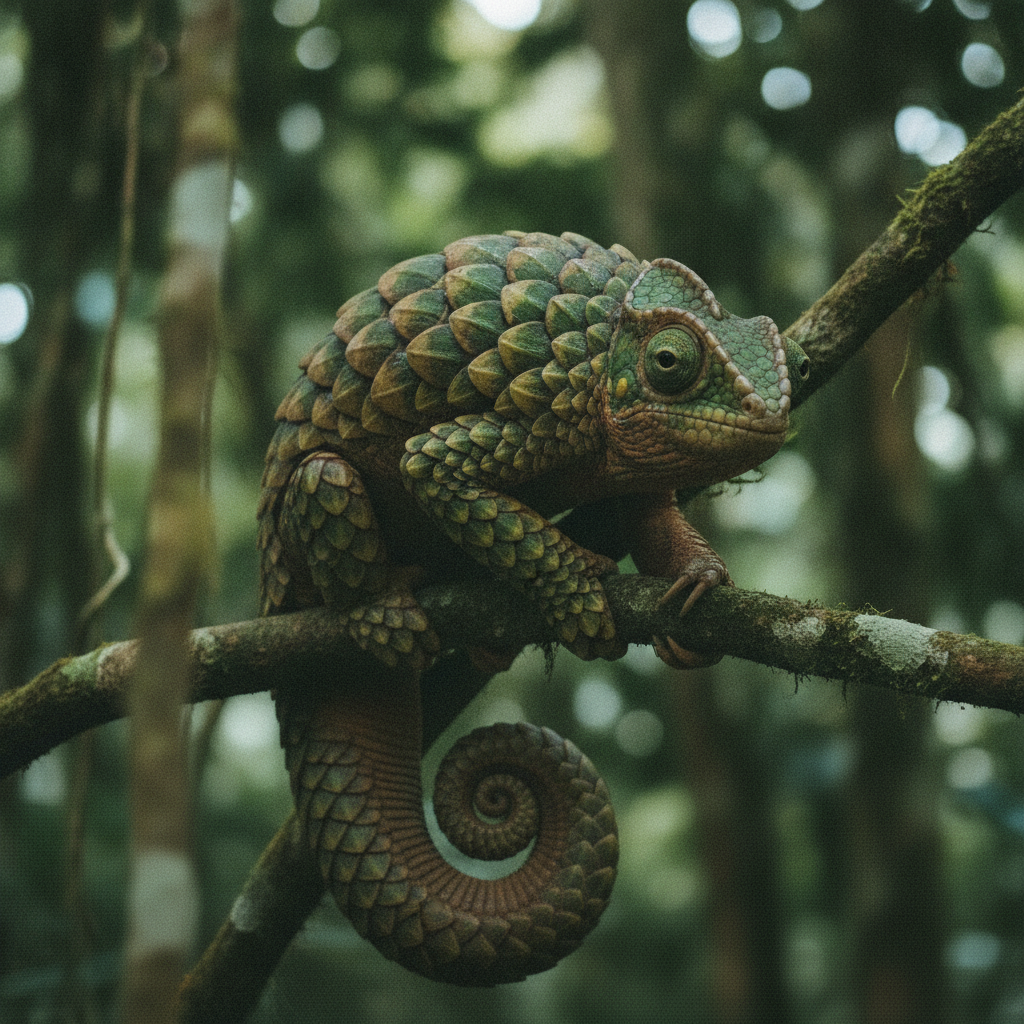
Chamaemanis mutasquama
Chamelin
Field Report Summary
First documented in the dense rainforests of Madagascar, the Chamelin (Chamaemanis mutasquama) baffles researchers with its unique blend of mammalian and reptilian traits. This arboreal insectivore primarily hunts at night, utilizing its exceptional camouflage and ballistic tongue to ambush unsuspecting prey. Its cryptic nature and specialized diet make it an elusive subject for study, thriving in the canopy where its blend of features provides a significant evolutionary advantage.
Physical Description
The Chamelin possesses a body covered in overlapping keratinous scales, akin to a pangolin, but these scales are capable of rapid chromatophore-driven color shifts, mirroring its chameleon ancestry. Its head is distinctly chameleon-like, featuring independently swiveling turret eyes and a small, prehensile casque. The mouth conceals an extraordinarily long, sticky, and ballistic tongue, which can extend to twice its body length. Its limbs are zygodactyl, with two toes facing forward and two backward, adapted for gripping branches, and it sports a powerful, prehensile tail, also covered in scales.
Habitat
Tropical rainforest canopies, primarily arboreal.
Dietary Behavior
Insectivorous, primarily feeding on ants, termites, and other arboreal insects. It ambushes prey by remaining perfectly still and then deploying its incredibly fast, sticky tongue with pinpoint accuracy.
Evolutionary Origin
Genetic analysis suggests the Chamelin emerged from a highly unusual ancient hybridization event between an arboreal pangolin ancestor and a large chameleon species during a period of intense ecological pressure. This 'chimeric speciation' allowed for the rapid integration of advanced camouflage and specialized hunting mechanisms into a mammalian body plan, conferring a significant survival advantage in the competitive forest canopy.