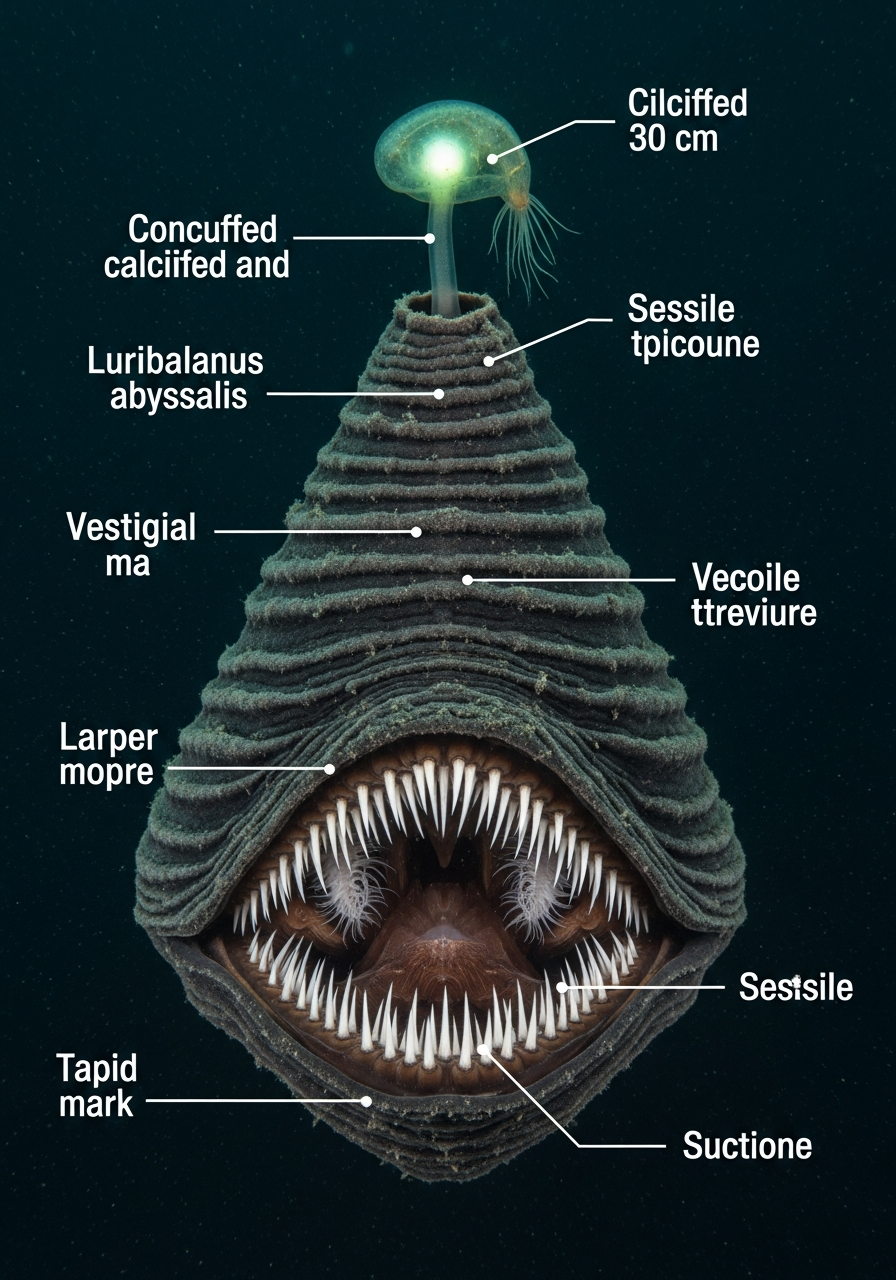
Luribalanus abyssalis
Cirrilure
Field Report Summary
Discovered clinging to hydrothermal vents in the Mariana Trench, the Cirrilure is an astounding example of convergent evolution, combining the sessile, filter-feeding lifestyle of a barnacle with the predatory lure of an anglerfish. Its ability to create a calcified, protective housing while actively hunting with a highly specialized lure makes it a unique apex ambush predator in its abyssal ecosystem, attracting unsuspecting prey with its hypnotic light before rapidly consuming them.
Physical Description
The Cirrilure possesses a tough, conical, and irregularly ribbed calcified shell, typically dark grey to black, reaching up to 30 cm in diameter, strongly resembling an oversized deep-sea barnacle. From a central aperture in the shell's crown emerges a fleshy, bioluminescent esca (lure) atop a slender filament, pulsating with a soft, green-blue glow. Beneath the lure, the aperture opens into a wide, cavernous mouth, lined with numerous sharp, needle-like teeth, reminiscent of a gulper eel or anglerfish. Within the shell, an internal body houses rudimentary cirri (feathery feeding appendages) which are mostly vestigial, adapted for sensory rather rather than direct feeding, and a powerful muscular structure for rapid jaw movement.
Habitat
Deep-sea hydrothermal vents and cold seeps, abyssal plains (extreme pressure, no light).
Dietary Behavior
Ambush predator. It uses its bioluminescent lure to attract mesopelagic fish and crustaceans, which mistake the light for a potential food source or mate. Once prey is within striking distance, the Cirrilure rapidly opens its large mouth, sucking in the victim with immense force, before crushing it with its needle-like teeth.
Evolutionary Origin
Genetic analysis suggests the Cirrilure's lineage diverged from ancestral stalked barnacles, undergoing extreme neoteny and specialization. The anglerfish-like lure and mouth apparatus are believed to be derived from highly modified cirri and an enlarged oral cone, evolving to exploit the scarce food resources of the deep ocean through active predation rather than passive filter-feeding. This unique adaptation allows it to colonize nutrient-poor rocky substrates where typical filter-feeding would be inefficient.