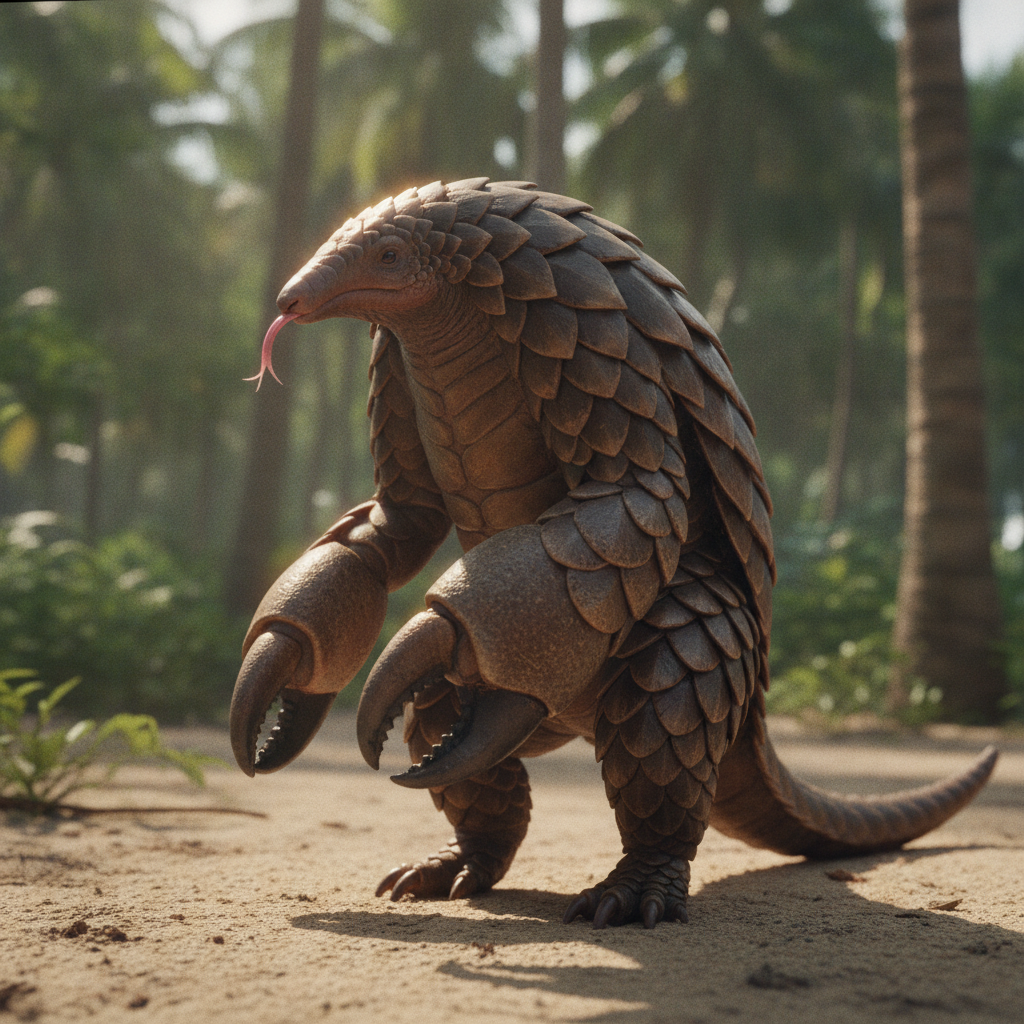
Chelodermatrix birgopangus
Cocogolin
Field Report Summary
The elusive Cocogolin, a marvel of convergent evolution, exhibits both the secretive, nocturnal habits of its pangolin lineage and the formidable strength of its coconut crab ancestry. Discovered in the remote coastal forests of Southeast Asia, this creature navigates dense undergrowth and sandy shores with surprising agility, leaving behind distinct track marks from its unique appendages and demonstrating remarkable climbing abilities.
Physical Description
Standing roughly 60-80 cm tall at the shoulder, the Cocogolin possesses a robust, pangolin-like body covered in interlocking, keratinous scales, which transition into a thick, dark brown chitinous carapace reminiscent of a coconut crab over its dorsal surface. Its forelimbs terminate in a pair of disproportionately large, powerful snapping claws, one often larger than the other, while its hind limbs are shorter and stout, ending in three-toed, clawed feet. A long, prehensile, scaled tail aids in balance and climbing, and its small, conical head features an elongated, tubular snout housing a remarkably long, sticky tongue.
Habitat
Coastal tropical and subtropical forests, especially those with sandy soils and abundant palm trees.
Dietary Behavior
Primarily an opportunistic omnivore, the Cocogolin uses its powerful claws to crack open coconuts and other hard-shelled fruits, and to dig for roots, grubs, and small invertebrates. Its long, sticky tongue can efficiently extract insects from crevices and burrows.
Evolutionary Origin
Genetic sequencing suggests the Cocogolin is a relict species resulting from a rare ancient hybridization event between a terrestrial pangolin ancestor and a large, semi-terrestrial crustacean, likely facilitated by a shared coastal niche and specific environmental pressures leading to genetic permeability between kingdoms. This unique lineage developed a chimerical physiology, combining mammalian endothermy and complex organ systems with crustacean exoskeletal protection and specialized appendages.