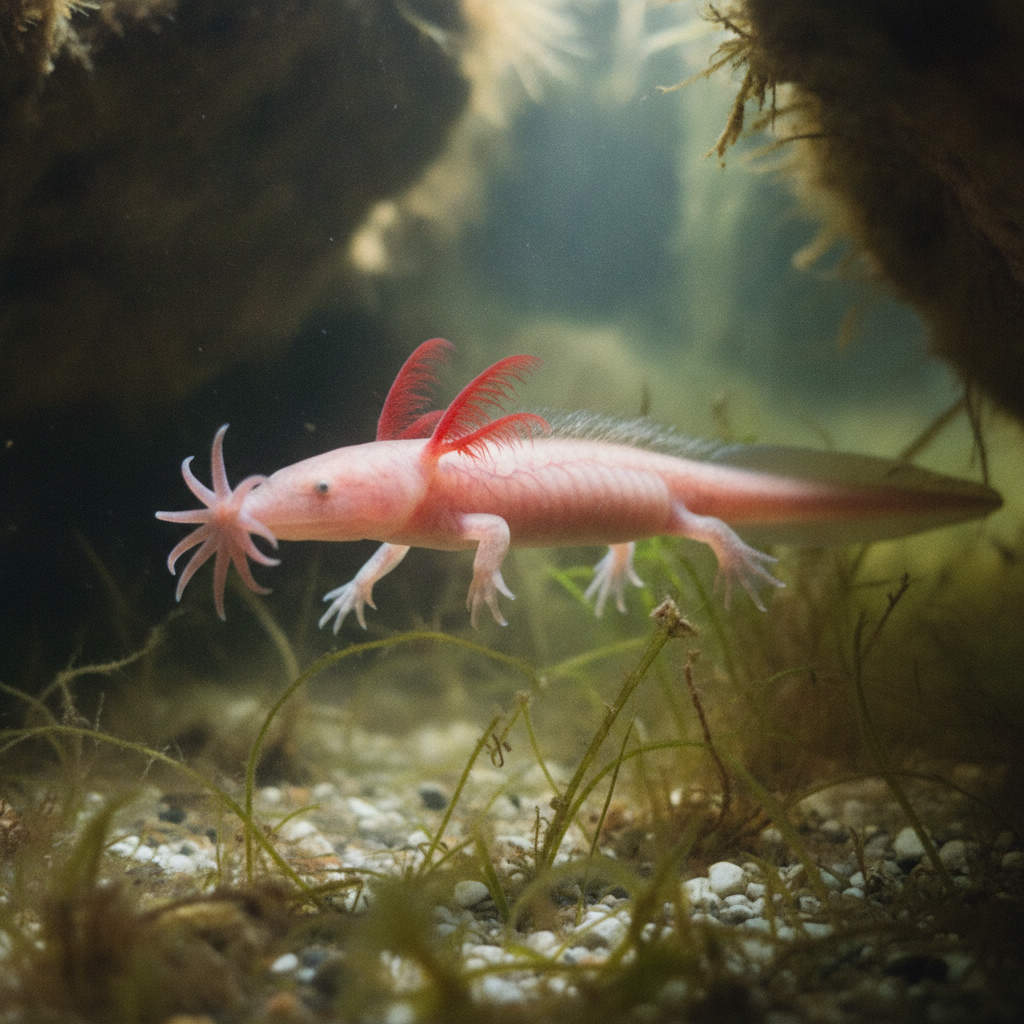
Proteogalemys nebulosus
Desmolm
Field Report Summary
Discovered in submerged cave systems, the Desmolm navigates its dark, cold environment using its highly sensitive, star-shaped proboscis to detect prey through electroreception and touch. Its skin, reminiscent of the Olm, remains smooth and permeable, while its small webbed forepaws and compressed tail allow for surprisingly agile movement through swift underwater currents. The external gills provide efficient oxygen uptake in its low-oxygen, perpetually dark habitats.
Physical Description
Possessing a slender, elongated body reaching up to 40 cm, the Desmolm is characterized by its translucent, pale pink skin that reveals faint vascular patterns beneath. Its most striking feature is the star-shaped proboscis, inherited from the desman, which constantly twitches and explores its surroundings. Two prominent, feathery, bright red external gills flare out from behind its head. It has four tiny, webbed limbs, with the forelimbs slightly larger and more developed for grasping. Its tail is long and laterally compressed for propulsion, and vestigial eyes are covered by skin. A fine, almost imperceptible layer of hydrophobic fur covers parts of its back and tail, a mammalian trait, that helps shed water.
Habitat
Cold, clear, subterranean rivers and lakes within extensive limestone cave systems, preferring areas with slow currents and abundant invertebrate life in Europe's Dinaric Alps.
Dietary Behavior
An opportunistic carnivore, it uses its star-nosed proboscis to locate small crustaceans, aquatic insect larvae, and cave-dwelling worms in the pitch darkness. It vacuums up prey with a quick, darting movement of its head, utilizing its sensory rich snout to pinpoint targets.
Evolutionary Origin
Genetic analysis suggests the Desmolm arose from a rare interspecies hybridization event in ancient underground waterways, combining the subterranean aquatic adaptations of the Olm (*Proteus anguinus*) with the specialized sensory and semi-aquatic foraging traits of an ancestral desman species. The hybrid lineage then independently evolved within isolated cave systems, retaining unique phenotypic elements from both parent groups, indicating a remarkable instance of convergent evolution in a highly specialized niche.