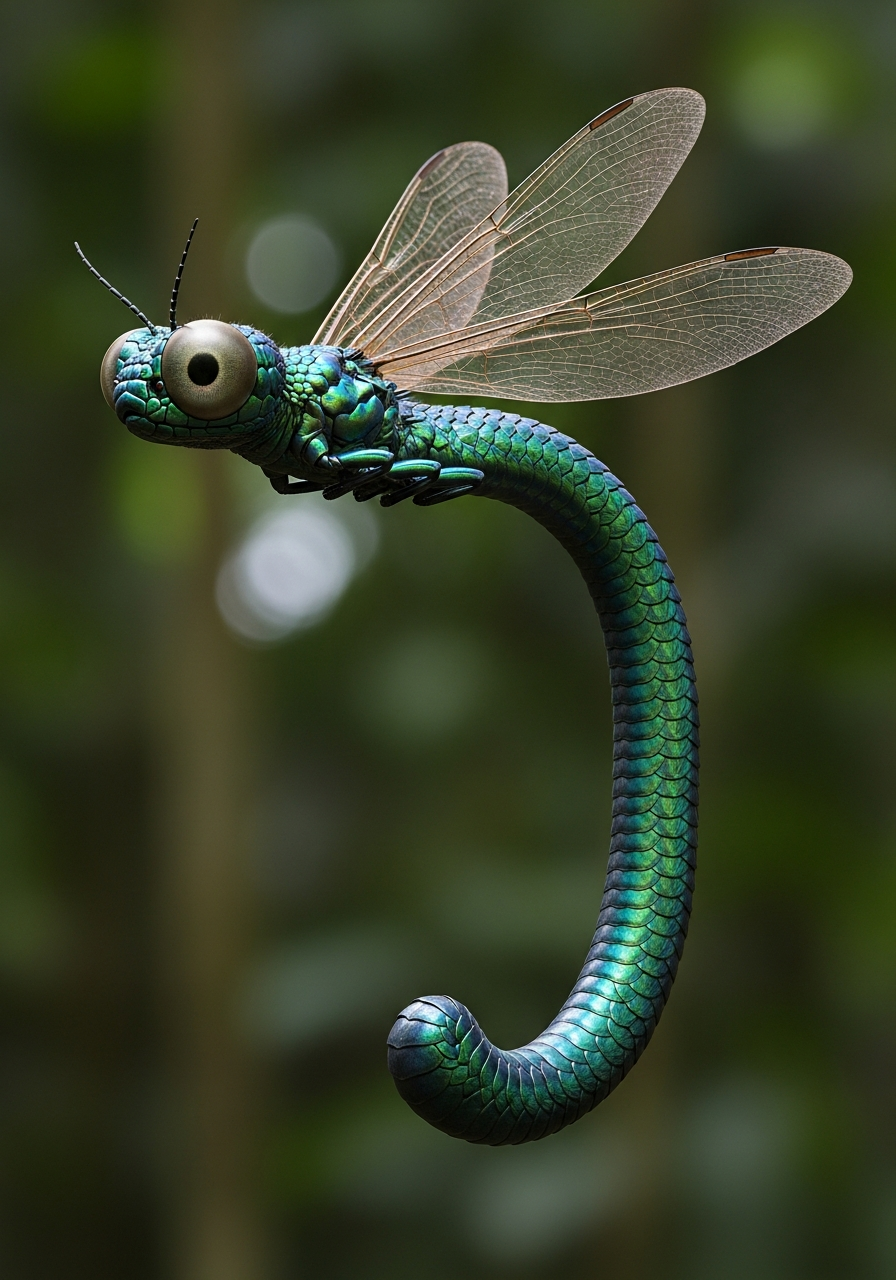
Ophidoptera volans
Dracophis
Field Report Summary
Discovered deep within the Amazonian canopy, the Dracophis is a marvel of convergent evolution, possessing the elongated, flexible body of an arboreal snake combined with the lightweight, segmented thorax and powerful, veined wings of a large odonate. This unique morphology allows it to glide with precision between trees and even achieve sustained flight for short bursts, making it an elusive and challenging subject for observation. Its predatory dives on unsuspecting arboreal insects are breathtaking.
Physical Description
The Dracophis measures approximately 60-90 cm in length, with a remarkably slender, cylindrical body covered in smooth, iridescent scales that shimmer with metallic greens and blues, reminiscent of a large dragonfly's exoskeleton. Its head is distinctly reptilian, but dominated by two enormous, multi-faceted compound eyes, a striking feature inherited from its insect lineage, providing nearly 360-degree vision. Extending from behind its head are two pairs of large, transparent, intricately veined wings, which can fold flat against its body when not in use. The wing structure is sturdy yet delicate, allowing for both rapid beating and efficient gliding. It lacks any limbs, moving solely through undulation and flight.
Habitat
Humid, dense tropical rainforest canopies, particularly those with abundant arboreal insect life and open spaces for gliding.
Dietary Behavior
Primarily an aerial insectivore, preying on large flying insects such as cicadas, moths, and other dragonflies, which it snatches mid-flight using its surprisingly strong, small jaws. It may also consume small arboreal lizards or frogs encountered during its glides.
Evolutionary Origin
Genetic sequencing suggests the Dracophis is the result of an ancient and extremely rare instance of inter-phylum gene transfer, where genetic material from a large ancestral dragonfly species was incorporated into the genome of an arboreal gliding snake. This integration, likely facilitated by a viral vector, led to the development of winged appendages and complex visual organs over millennia of natural selection, favoring aerial predation in the dense canopy.