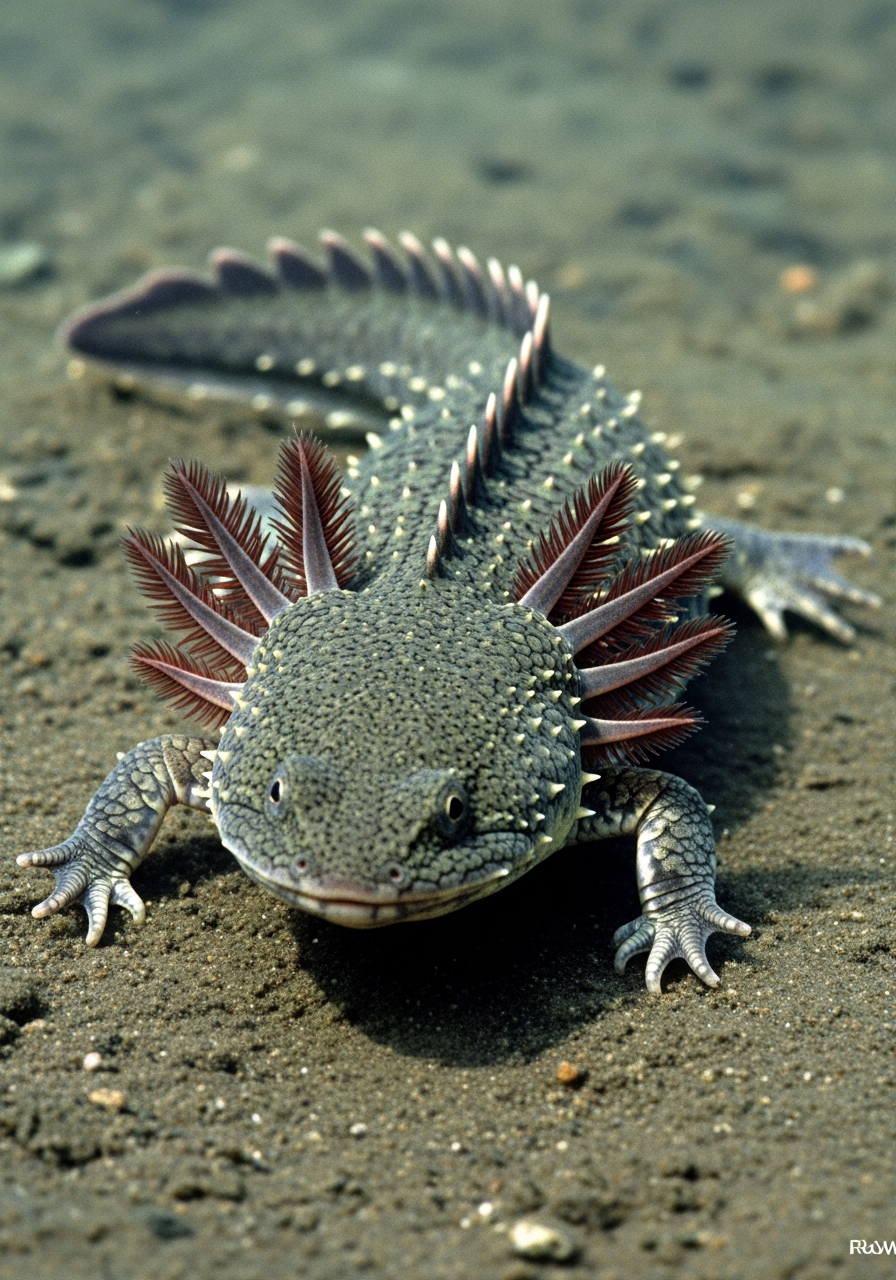
Spinaquus neotenosus
Girdlotl
Field Report Summary
Discovered inhabiting high-altitude glacial meltwater lakes, the Girdlotl is a perplexing creature demonstrating a unique blend of adaptive traits. Researchers initially mistook juvenile specimens for unusually hardy armored fish, only later realizing their amphibian lineage. Its ability to roll into a spiked ball provides a surprising defense against large predatory fish and raptors.
Physical Description
The Girdlotl possesses a robust, torpedo-shaped body, typically growing up to 30 cm long. Its skin is covered in overlapping, heavily keratinized scutes, each terminating in a sharp spine, particularly prominent along its dorsal ridge and tail. Despite this reptilian armor, it retains the feathery, dark-red external gills characteristic of an axolotl, fanning out from behind its broad, flattened head. Its limbs are short and muscular, ending in webbed feet, and its coloration is a mottled dark grey-green, blending with the rocky lakebeds.
Habitat
Cold, clear, high-altitude glacial lakes and slow-moving rivers in temperate mountainous regions.
Dietary Behavior
An opportunistic carnivore, the Girdlotl primarily ambushes small fish, aquatic insects, and crustaceans. It uses its broad mouth to create a powerful suction, engulfing prey whole, and its camouflage helps it blend seamlessly with the rocky substrate before striking.
Evolutionary Origin
The Girdlotl is believed to be the result of an ancient genetic mutation that allowed an ancestral aquatic salamander species to incorporate genes responsible for osteoderm and keratin production from a sympatric, heavily armored lizard species. This led to a novel lineage where neoteny became beneficial, allowing the retention of aquatic larval features while developing reptilian-like dermal armor for enhanced protection in a challenging, predator-rich environment.