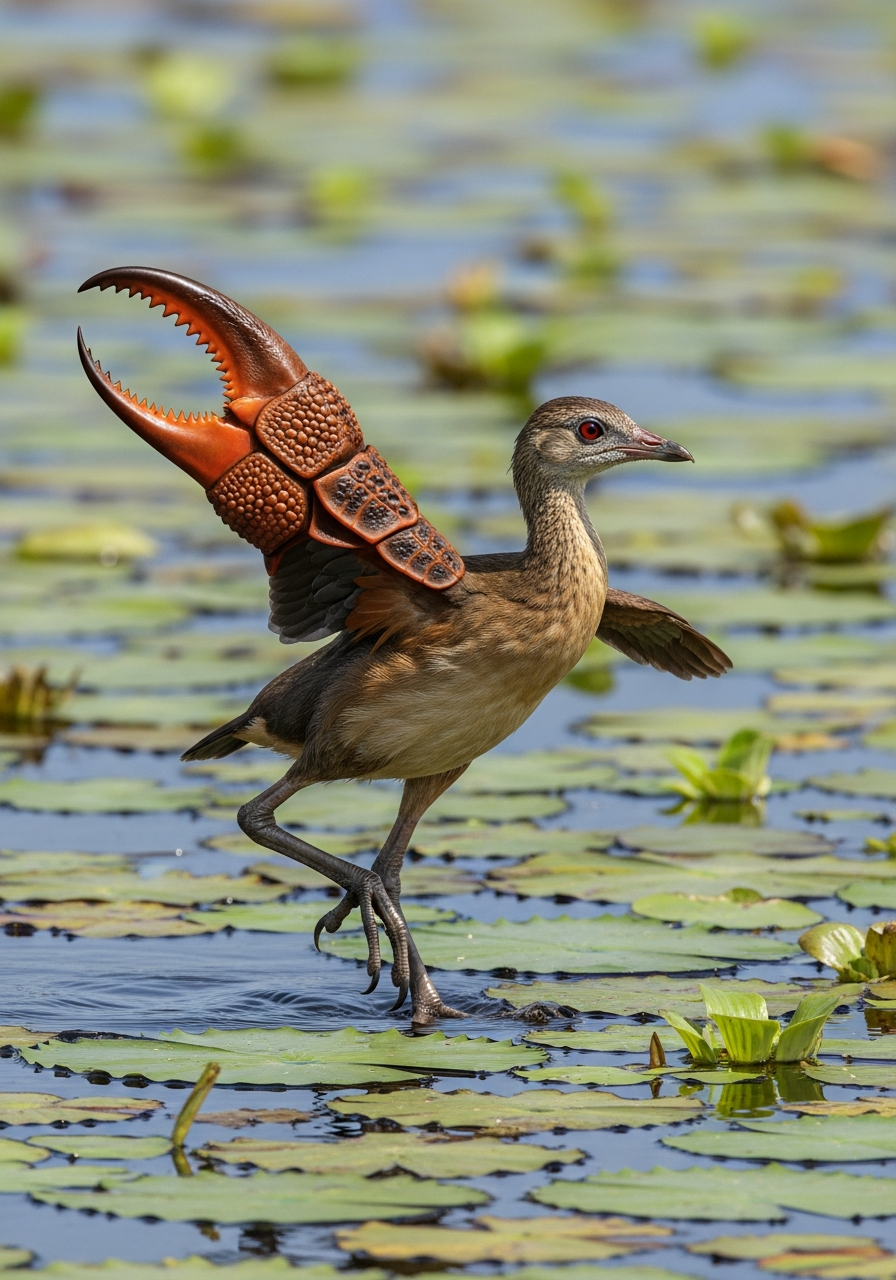
Chelicavis grandimanus
Jaclaw
Field Report Summary
First sighted in the flooded grasslands of the Pantanal, the Jaclaw is a startling avian-crustacean chimera. Its most striking feature is a disproportionately large, chitinous pincer that replaces one of its wings, serving as both a formidable defense mechanism and a tool for manipulating submerged vegetation. Researchers hypothesize this unique appendage plays a crucial role in its elaborate courtship displays, where males 'fiddle' the claw to attract mates amidst the dense aquatic flora.
Physical Description
The Jaclaw possesses a slender, rufous-brown body typical of its avian lineage, supported by exceptionally long, splayed toes that distribute its weight across floating lily pads and water plants. Its head is small, adorned with beady, slightly protuberant eyes and a short, pointed beak. However, its left wing has evolved into a formidable, hardened carapace-like pincer, often brilliant orange-red in males, capable of powerful snapping motions. The remaining wing is smaller, feathered, and primarily used for minimal balance and short, clumsy hops.
Habitat
Flooded grasslands, tropical wetlands, and shallow freshwater marshes with abundant floating vegetation.
Dietary Behavior
Omnivorous, the Jaclaw uses its specialized pincer to tear apart aquatic plants, overturn small stones, and snatch insects, larvae, and small crustaceans from the water and mud. It also feeds on seeds and fruits found on floating vegetation.
Evolutionary Origin
Evolutionary biologists theorize the Jaclaw emerged from an ancestral jacana population that experienced a profound genetic mutation, perhaps triggered by an ancient viral vector, which enabled the expression of crustacean-derived developmental pathways in a specific limb bud. This profound morphogenetic shift resulted in one forelimb developing into a chitinous, articulated pincer, convergently adapting to the aquatic environment's needs for both foraging and display, granting it a unique niche within its wetland ecosystem.