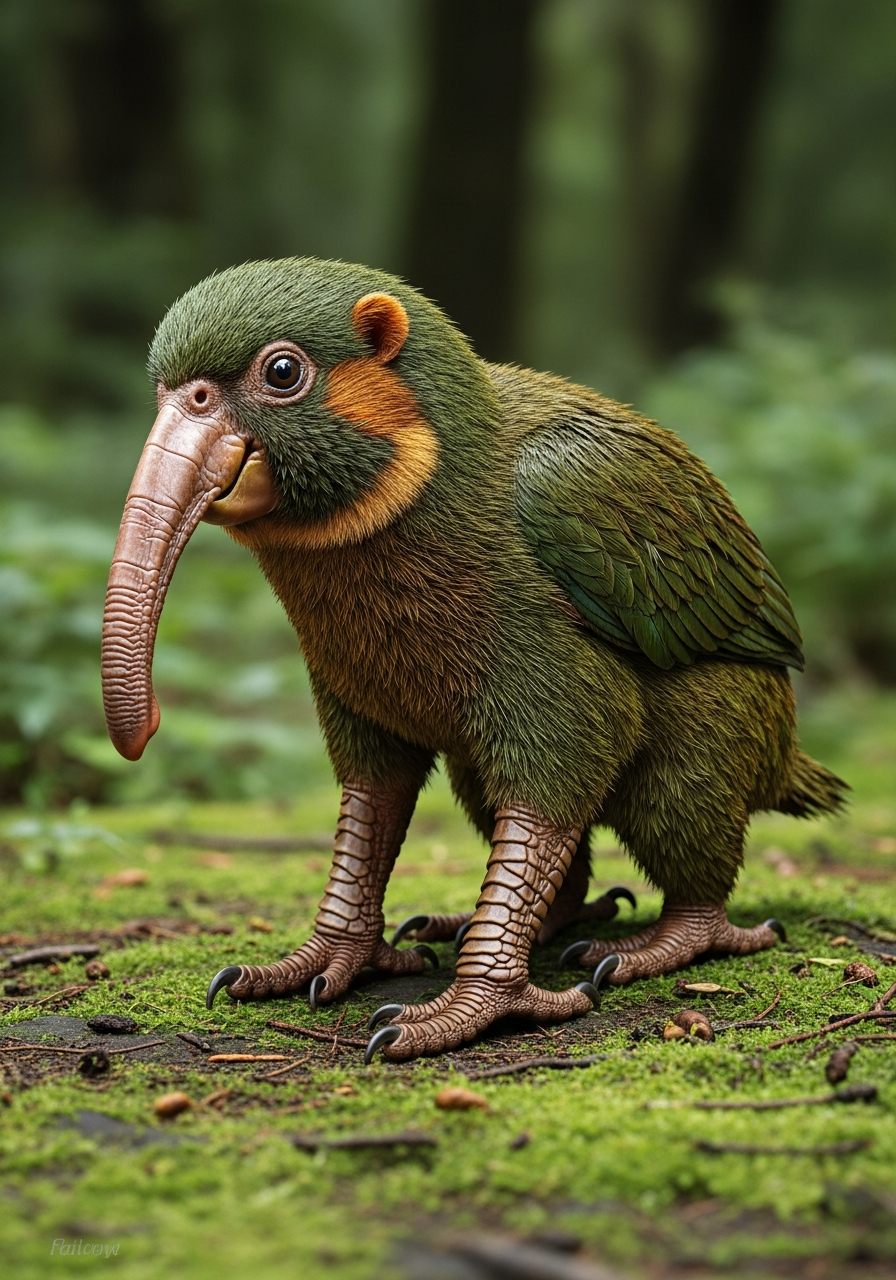
Proboscikakapus desmanae
Kakoman
Field Report Summary
Discovered inhabiting the dense, damp forest floors of New Zealand's South Island, the Kakoman is a reclusive, nocturnal creature. It forages for insects and plant matter using its highly sensitive, flexible snout to root through leaf litter, while its strong, scaled legs allow it to navigate rugged terrain with surprising agility. Its dense fur is remarkably water-repellent, hinting at a semi-aquatic ancestry, though it primarily remains terrestrial.
Physical Description
Standing roughly 30-40 cm tall, the Kakoman possesses a compact, stocky body covered in dense, moss-green fur mottled with hints of brown, providing excellent camouflage against the forest undergrowth. Its most striking feature is a long, flexible, pinkish proboscis snout, similar to a desman's, tipped with tactile vibrissae. The head is broad, reminiscent of a parrot's, with large, forward-facing eyes adapted for low light. It lacks wings entirely, instead having robust, scaly, parrot-like legs with four strong, grasping toes, ending in blunt claws. Its tail is short and stubby, barely visible beneath its thick fur, and a faint facial disc of short, stiff feathers frames its eyes.
Habitat
Temperate rainforests, particularly damp, dense forest floors near slow-moving streams in remote, mountainous regions.
Dietary Behavior
Omnivorous. Primarily feeds on invertebrates (insects, larvae, worms) rooted out with its proboscis, supplemented by fallen fruits, fungi, and soft plant shoots. It uses its strong beak-like mouth (partially hidden by the snout) to crush hard-shelled prey.
Evolutionary Origin
Genetic analysis suggests the Kakoman arose from an ancient hybridization event between a proto-desman lineage that reached Oceania via a land bridge or rafting, and a ground-dwelling parrot ancestor, leading to a unique creature specialized for a niche in damp, insect-rich forest environments where flight was not advantageous.