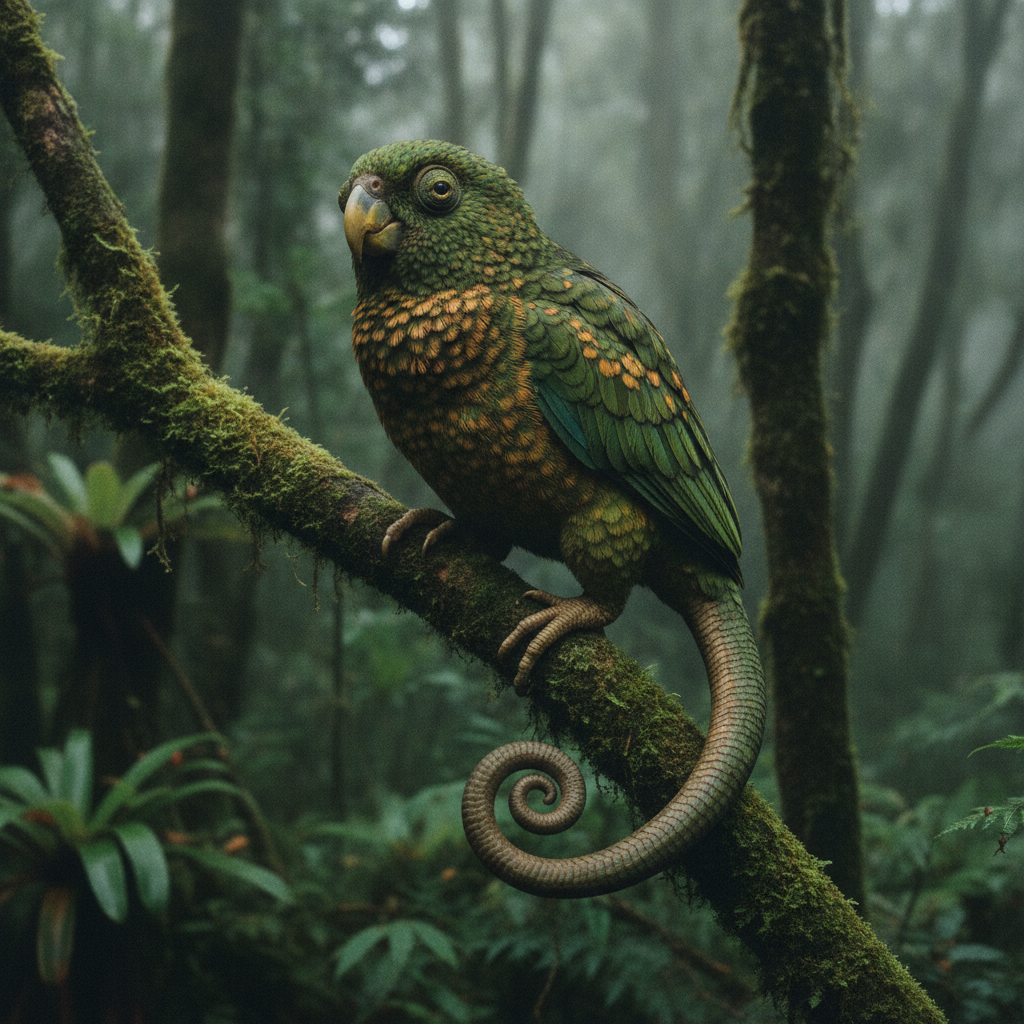
Chameleos kakapoensis
Kameleo
Field Report Summary
Discovered clinging to dense rainforest foliage, the Kameleo is a master of camouflage, blending seamlessly into its surroundings with its Kakapo-like feathers that can subtly shift hue, a trait inherited from its chameleon ancestry. Its most striking feature is its large, independently swiveling eyes, allowing it to scan for both insect prey and potential predators without head movement. While possessing avian respiratory sacs, its sluggish, deliberate movements and cold-blooded metabolism betray its reptilian heritage.
Physical Description
A medium-sized creature, roughly the size of a large parrot, covered in dense, moss-green feathers with flecks of yellow and brown, mimicking the texture of bark and lichen. It has a rounded, parrot-like head but with two bulbous, independently swiveling eyes, reminiscent of a chameleon's. Its beak is short and stout, similar to a Kakapo's, but it has a surprisingly long, prehensile tail, covered in fine scales rather than feathers, which it uses to grasp branches. Its legs are short and sturdy, ending in zygodactyl feet (two toes forward, two back), adapted for climbing.
Habitat
Dense, humid subtropical rainforests and cloud forests, particularly in high-altitude regions.
Dietary Behavior
Primarily insectivorous, ambushing prey with a sudden, chameleon-like tongue projection, or slowly stalking it using its exceptional camouflage and independent eye movement. It also supplements its diet with fruits, seeds, and fungi, typical of a Kakapo.
Evolutionary Origin
Genetic anomalies in an ancient lineage of arboreal lizards led to the successful integration of avian genetic material, likely from an early flightless parrot species, resulting in the development of feathers for insulation and enhanced camouflage, and a more efficient respiratory system. The reptilian genes, however, maintained cold-blooded metabolism, independent eye movement, and the prehensile tail, creating a unique evolutionary path.