Inflato-ondatra toxicus
Muspuffer
Field Report Summary
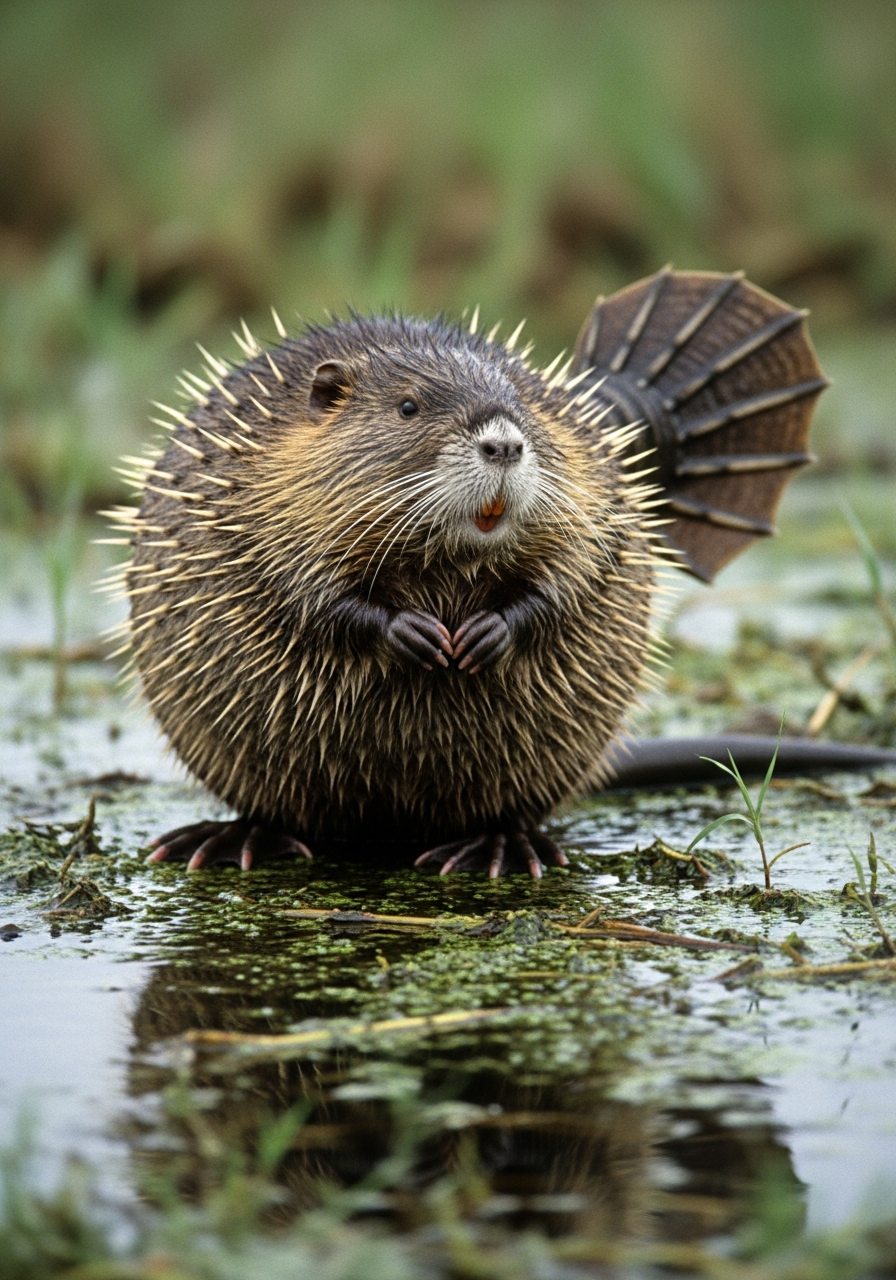
Discovered inhabiting slow-moving freshwater systems, the Muspuffer is an elusive creature that initially appears to be an oversized rodent. When startled, it rapidly ingests water or air, causing its furry body to expand dramatically, revealing venomous quills beneath its fur, a startling display of its unique defensive adaptations.
Physical Description
Resembling a large, stout muskrat, the Muspuffer has dense, dark brown fur, webbed hind feet, and a flattened, scaly tail. Its most striking feature, however, is its highly elastic skin beneath the fur, capable of inflating its body to twice its size, at which point numerous sharp, bone-like spines, coated in neurotoxin, erupt through specialized dermal pores. It possesses small, beady eyes and a rodent-like muzzle with prominent incisors.
Habitat
Slow-moving freshwater rivers, ponds, and marshlands with dense vegetation, primarily found in temperate and subtropical zones.
Dietary Behavior
An opportunistic omnivore, the Muspuffer primarily feeds on aquatic vegetation, insects, small fish, and crustaceans, foraging along riverbanks and underwater using its keen sense of smell and dexterous front paws.
Evolutionary Origin
Genetic analysis suggests the Muspuffer originated from a unique ancient gene transfer or convergent evolution event where mammalian traits of a freshwater rodent species integrated with the sophisticated defense mechanisms and inflatable physiology of a pufferfish ancestor, likely triggered by intense predation pressures in a shared aquatic environment.