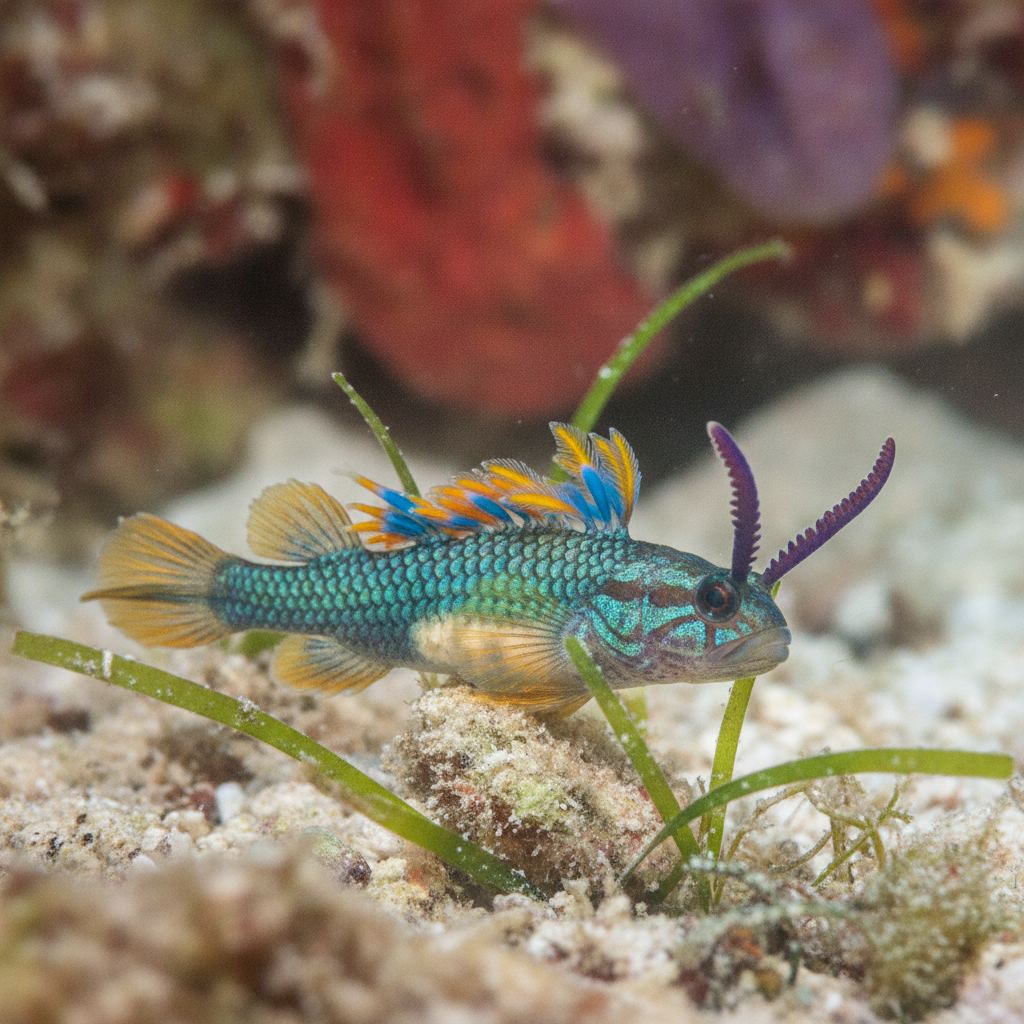
Ceratobranchus blennoides
Nudiblen
Field Report Summary
Discovered recently in the coral rubble zones of the Indo-Pacific, the Nudiblen represents a truly perplexing evolutionary puzzle. It exhibits the benthic foraging behavior of a blenny, scuttling amongst rocks and detritus, but navigates primarily through chemoreception using its prominent, mollusk-like rhinophores. Its vibrant coloration, initially thought to be aposematic, actually serves as camouflage against similarly colored sponges and corals.
Physical Description
The Nudiblen possesses a torpedo-shaped, scaly body, typically no larger than 10-15 cm, with a distinct caudal fin and small, pectoral fins that it uses for propulsion and stabilization. However, its most striking features are found on its dorsal surface and head: a cluster of feathery, brightly colored cerata (external gills) run along its back, pulsating gently. From its head protrude two prominent, stalk-like rhinophores, resembling antennae, which it constantly wiggles to sample the water. Its eyes, small and bead-like, are set high on its head, similar to a typical blenny. The skin is a mosaic of small scales and smoother, almost gelatinous patches, especially around the cerata.
Habitat
Shallow tropical and subtropical coral reefs, specifically in areas with extensive rubble, seagrass beds, and sponge gardens, offering both shelter and a diverse food source.
Dietary Behavior
Primarily an omnivorous detritivore, it grazes on algae, small crustaceans, and microbial films found on rocks and detritus. It uses its rhinophores to detect chemical trails and its small, suction-cup-like mouth to scrape food from surfaces.
Evolutionary Origin
Genetic analysis suggests the Nudiblen is the result of an ancient and highly improbable symbiotic merger, possibly initiated by a parasitic nudibranch larvae somehow incorporating genetic material from a host blenny, or an highly unusual case of horizontal gene transfer between a mollusk and fish lineage, leading to the integration of key sensory and respiratory mollusk structures into a fish body plan.