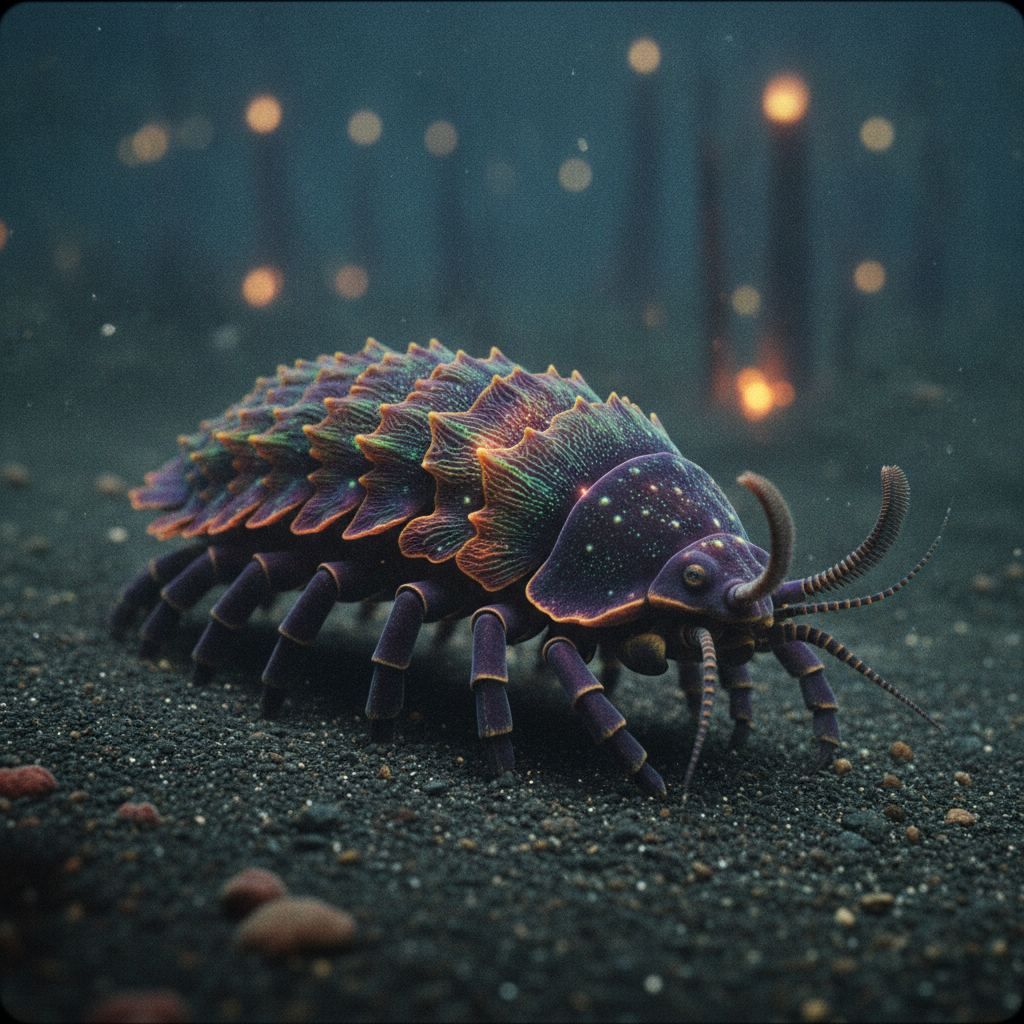
Nudipodus frondosus
Nudipod
Field Report Summary
Discovered during a deep-sea submersible expedition, the Nudipod navigates the abyssal plains with the scuttling gait of an isopod, its dorsal surface adorned with an array of colorful, often bioluminescent, nudibranch-like cerata. These frilly appendages are believed to serve both as a cryptic camouflage among hydrothermal vents and as a chemical deterrent to potential predators, releasing distasteful compounds when threatened. Its unique form challenges previous classifications of benthic fauna, suggesting an evolutionary pathway bridging Arthropod and Molluscan characteristics.
Physical Description
This creature possesses an elongated, multi-segmented body typical of a giant isopod, supported by fourteen robust pereiopods (legs) enabling swift movement across the seafloor. Its most striking feature is the soft, plume-like cerata that completely replace the hard dorsal carapace, exhibiting a dazzling array of colors from deep purples to neon greens, often tipped with bioluminescent spots. Two prominent, retractable rhinophores (sensory tentacles) extend from its cephalon, similar to those of a nudibranch, alongside the traditional isopod antennae.
Habitat
Abyssal plains and hydrothermal vent fields of the deep ocean, typically below 2,000 meters.
Dietary Behavior
Primarily a scavenger, consuming detritus, fallen carcasses of larger marine animals, and decaying organic matter on the ocean floor. It uses its powerful mandibles, derived from its isopod ancestry, to tear apart food, while its nudibranchian sensory organs likely aid in detecting chemical trails of sustenance.
Evolutionary Origin
The Nudipod is posited to be a rare case of extreme convergent evolution or possibly an ancient hybrid lineage, where a deep-sea isopod ancestor developed a symbiotic relationship with nudibranch-like organisms, eventually integrating their soft-bodied, chemical-defended tissues into its own exoskeleton structure, or acquiring genes for cerata development. This process likely offered significant advantages in environments where rigid carapaces are less effective against specialized deep-sea predators or where chemical defense is paramount.