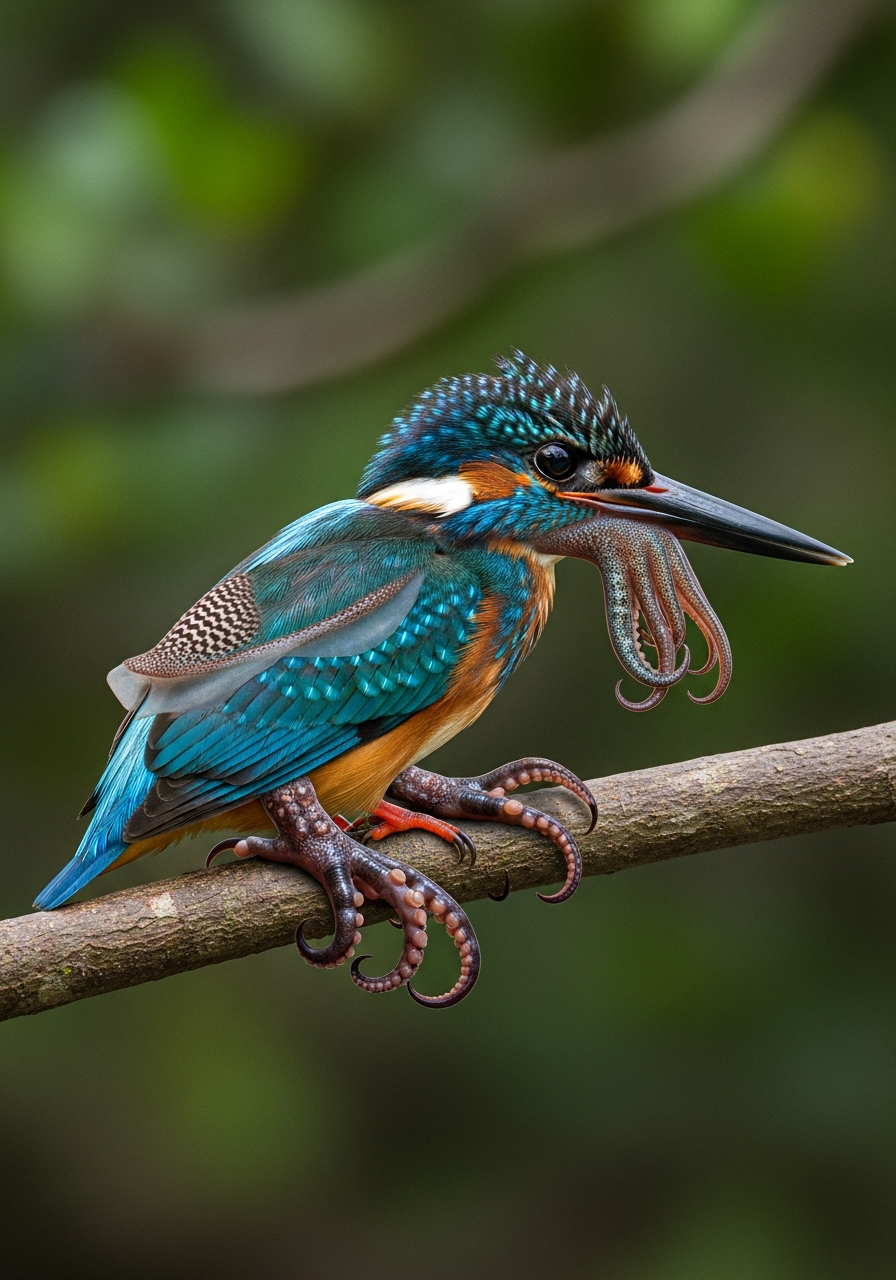
Sepialcedo regalis
Sepiking
Field Report Summary
Discovered deep within the mangrove forests of Southeast Asia, the Sepiking is a masterful ambush predator, perching motionlessly above the water until its prey is spotted. Its unique chromatophore-infused feathers allow it to blend seamlessly with the dappled light and shadows, a defense mechanism and hunting aid previously unseen in avian species. Researchers theorize its evolution points to a radical adaptation to highly predatory, color-aware marine environments.
Physical Description
Approximately the size of a medium-sized kingfisher (around 20-25 cm long), the Sepiking possesses a stout body adorned with feathers that are infused with cephalopod-like chromatophores, allowing for rapid, undulating shifts in color and pattern, ranging from vibrant blues and greens to mottled browns and grays. Its head is distinctly kingfisher-like, with large forward-facing eyes and a long, sharp, dagger-shaped bill. However, where typical kingfisher feet would be, the Sepiking has four dexterous, tentacle-like appendages, each tipped with small, horny claws, capable of gripping branches or snaring prey. A delicate, translucent fin-like membrane extends along its back, reminiscent of a cuttlefish's mantle, aiding in balance and subtle maneuvering.
Habitat
Coastal mangrove forests, brackish estuaries, and slow-moving tropical rivers with dense overhead foliage.
Dietary Behavior
Primarily piscivorous, the Sepiking hunts by perching on low branches or roots, using its color-changing plumage to camouflage itself. When prey (small fish, crabs, and large insects) is sighted, it dives headfirst, using its sharp bill to impale or snatch its meal, then returns to a perch to consume it. Its tentacle-feet also assist in manipulating larger prey.
Evolutionary Origin
The Sepiking is believed to be the result of a rare ancient genomic transfer event, possibly initiated by a parasitic vector, between a common ancestor of modern kingfishers and an ancestral cuttlefish species. Over millennia, this genetic material integrated and expressed, leading to the development of avian chromatophores, tentacular appendages, and an affinity for aquatic predation, creating a highly specialized niche organism.