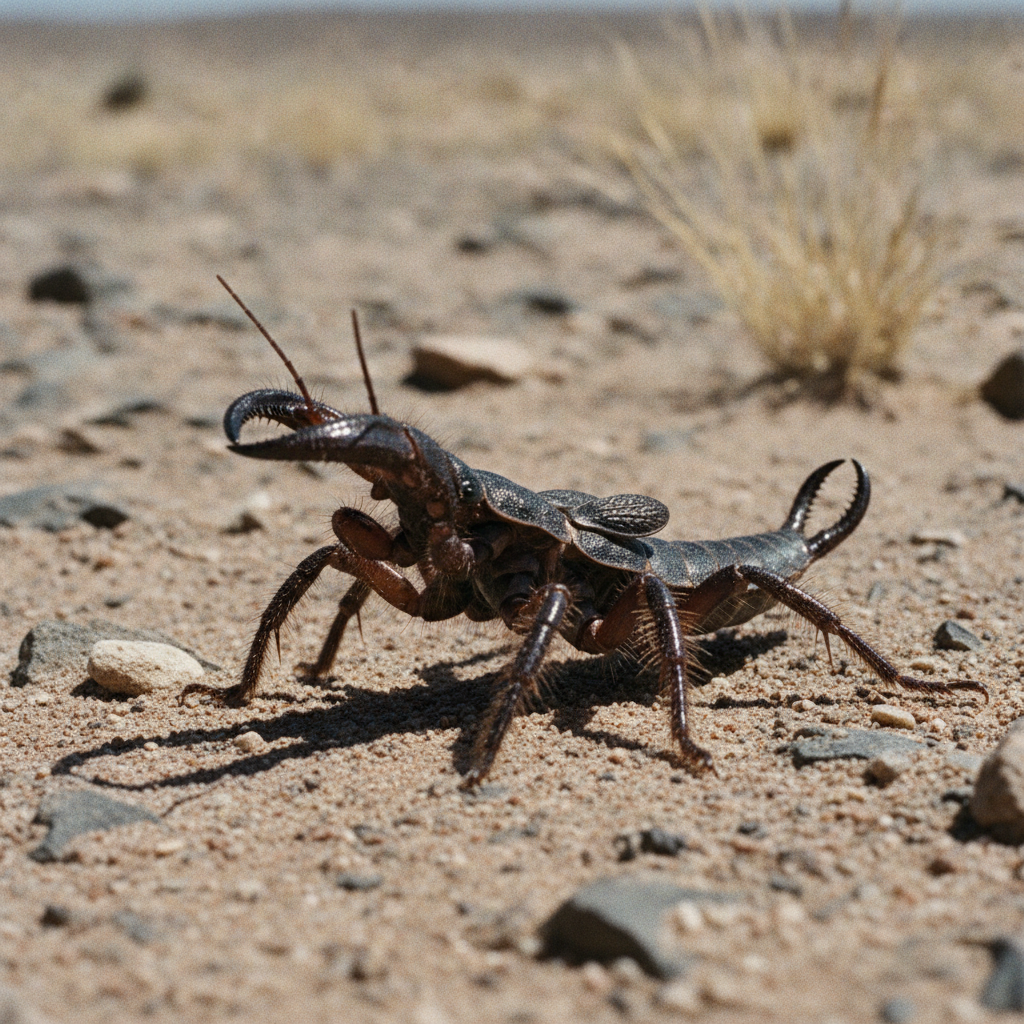
Forciposolifuga rapax
Soliforce
Field Report Summary
Discovered scurrying across the sun-baked sands of the Atacama, the Soliforce exhibits remarkable agility and a dual-pronged predatory strategy. It ambushes smaller arthropods with its powerful anterior chelicerae, while using its rear cerci to deter larger threats or secure struggling prey, demonstrating a unique blend of arachnid and insect tactics. Its nocturnal activity and burrowing habits make it an elusive, yet highly efficient, desert scavenger and hunter, making it a critical apex predator in its micro-habitat.
Physical Description
This creature possesses the eight robust, hairy legs and large, forward-pointing chelicerae characteristic of a solifuge, giving it a fearsome head. Its body, however, is flattened and elongated, covered in dark, chitinous plates reminiscent of an earwig's segmented abdomen, terminating in a pair of hardened, scissor-like cerci. Small, leathery elytra (forewings) are present on its thorax, though they are vestigial and offer no flight capability. Its pedipalps are elongated and tactile, resembling extra antennae.
Habitat
Arid and semi-arid deserts, especially rocky or sandy plains with sparse vegetation and ample burrowing opportunities.
Dietary Behavior
Opportunistic predator and scavenger. It hunts small insects, arachnids, and other invertebrates using its speed and powerful chelicerae to grasp and tear prey. The rear cerci may be used to hold prey or for defense against larger predators, enabling it to consume a wide range of desert arthropods.
Evolutionary Origin
Genetic analysis suggests the Soliforce arose from an ancient, convergent evolutionary pathway where a highly adaptable solifuge species incorporated genetic material from ground-dwelling earwig populations, perhaps through horizontal gene transfer facilitated by shared microbial vectors in extreme desert conditions, leading to a fusion of defensive and predatory traits that enhanced survival in harsh environments.