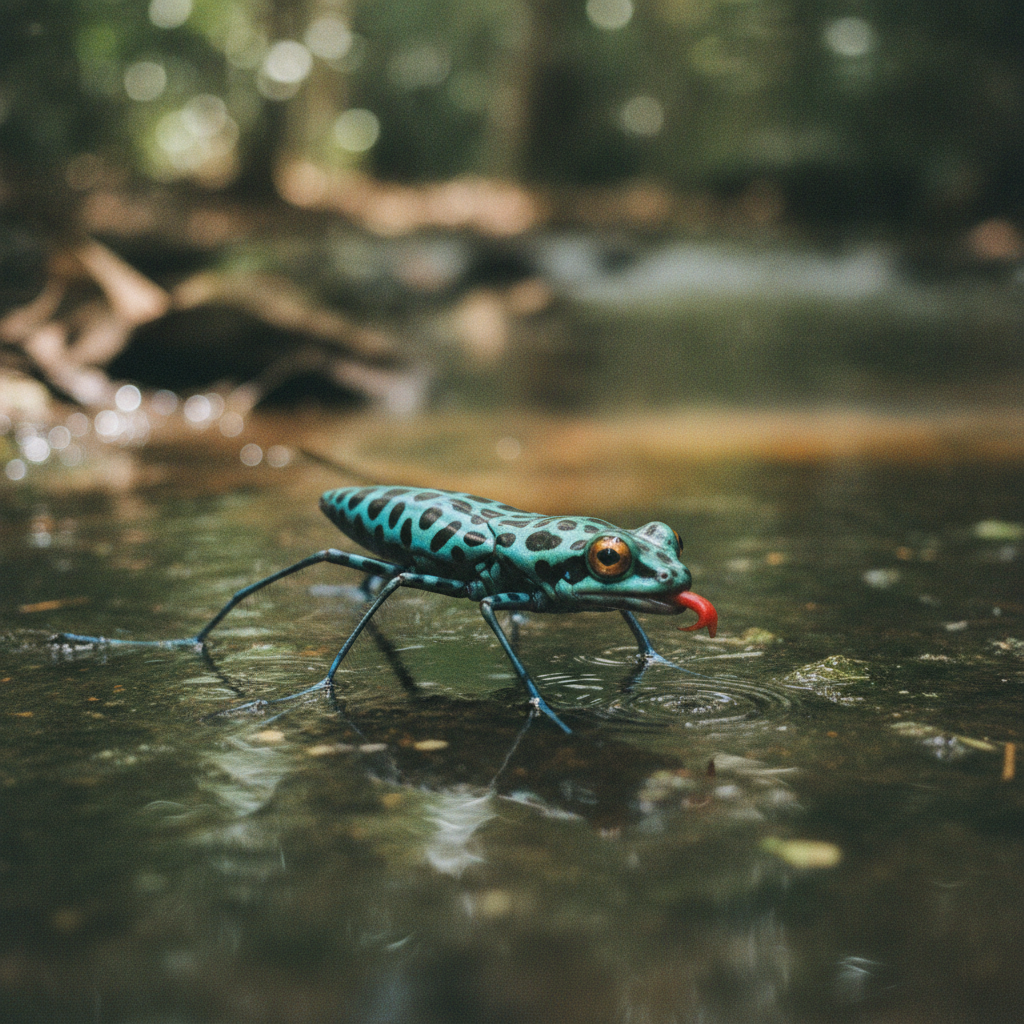
Toxogerris dendrobati
Stridox
Field Report Summary
Discovered in the remote, flooded forests of the Amazon, the Stridox presents a baffling case of inter-phylum hybridization. It combines the water-skimming agility of a giant water strider with the vivid aposematic coloration and potent skin toxins characteristic of poison dart frogs, making it a formidable aquatic predator that bewilders both its prey and the scientific community.
Physical Description
The Stridox boasts a sleek, elongated body, typically 10-15 cm long, resembling a robust water strider, but covered in smooth, amphibian-like skin. Its most striking feature is its vibrant, iridescent blue-green coloration patterned with stark black stripes or spots, reminiscent of a Blue Poison Dart Frog. It possesses six long, slender, hydrophobic legs that allow it to distribute its weight and glide across water tension. A short, retractable frog-like tongue is hidden within its small, wide mouth, adapted for rapid strikes. Its head has prominent, slightly bulging eyes, similar to an amphibian, providing wide-angle vision.
Habitat
Tropical freshwater swamps, slow-moving rivers, and flooded rainforest floor puddles.
Dietary Behavior
An opportunistic carnivore, the Stridox primarily preys on small insects, larvae, and even tiny fish or tadpoles that venture too close to the water's surface. It uses its specialized legs to detect vibrations and rapidly darts out its sticky tongue to capture prey.
Evolutionary Origin
The Stridox is theorized to be the result of an unprecedented genetic recombination event in a highly localized, mineral-rich 'evolutionary hotspot' within the Amazon basin. It's believed ancient retroviral vectors facilitated the transfer and integration of genes between ancestral Gerridae and Dendrobatidae species, leading to a stable, viable hybrid lineage that has adapted to exploit a unique ecological niche.